

 2 months ago
78
2 months ago
78
PROTECT YOURSELF with Orgo-Life® QUANTUM TECHNOLOGY
Orgo-Life the new way to the future Advertising by AdpathwayWhile editing a college magazine, our team once decided against publishing an article written by a professor. The piece wasn’t inaccurate, poorly argued or controversial. The concern was something else entirely: if someone searched for the professor’s name years later, the article would still show up online.
The decision wasn’t really about what had been written. It was about the possibility of being permanently attached to it.
That moment revealed something surprising. The real anxiety wasn’t over the article itself, but over its digital afterlife. Gen Z is perhaps the first generation to grow up without intellectual privacy, living in an era of permanent, searchable memory. The possibility that today’s half-formed thought could resurface years later encourages self-censorship long before people choose to speak.
For previous generations, academic freedom meant experimenting in relative obscurity — without the fear of being remembered forever. For Gen Z, it means something more: freedom from digital permanence. Classroom remarks and public discussions can now be shared widely, archived and stripped of the context in which they were made. Open inquiry depends on intellectual privacy — the freedom to test ideas without assuming they’ll become permanent records. The central question, then, is this: can universities remain spaces for free inquiry when every tentative thought has the potential to live forever online?
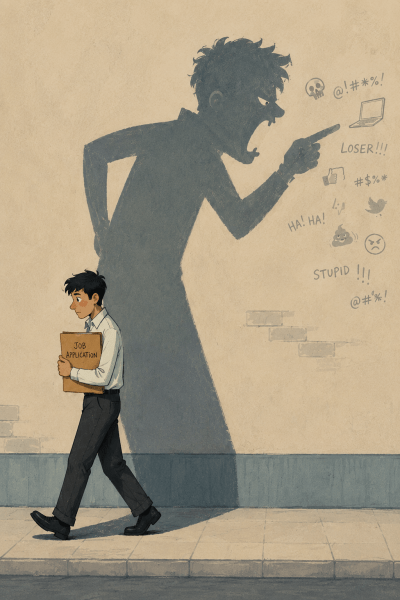 Search engines and algorithms not only preserve speech, they determine how visible it becomes.
The internet never forgets. And algorithms never stop watching.
In 2014, the University of Illinois withdrew the faculty appointment of Stevan Salaita after his old tweets resurfaced. The case shows how online memory can make intellectual discovery feel professionally risky.
Every communication technology has reshaped universities in different ways. The printing press expanded access to knowledge. Television widened its reach. The internet has introduced a different challenge altogether: it has dramatically extended both the audience and the lifespan of every public conversation.
Story continues below this ad
Search engines and algorithms not only preserve speech, they determine how visible it becomes.
Algorithms become an invisible audience—not because they interpret ideas, but because they decide who sees them, when, and how often.
In It’s Complicated: The Social Lives of Networked Teens, Dana Boyd argues that young people now construct their identities within “networked publics”, where communication is shaped by technologies that reward persistence, visibility, readability and searchability.
The result is what’s often called “context collapse”—ideas meant for one audience suddenly become available to countless others who lack the setting, purpose or nuance in which they were expressed. What begins as a tentative attempt to learn is often treated as a fixed public position.
Story continues below this ad
According to the 2026 College Free Speech Rankings by FIRE, 28% of students surveyed said they often self-censor during classroom discussions. This matters especially for Gen Z, whose identities and beliefs are still evolving. Learning requires making mistakes and revising opinions. But when every expression risks becoming part of a permanent online record, students begin asking not whether an idea is worth exploring, but whether they can afford to be associated with it years later. Education becomes less about intellectual experimentation and more about reputation management.
Why forgetting matters
For this generation to grow, society must also protect the ability to be forgotten. In the landmark Google Spain v. Agencia Española de Protección de Datos (2014) case, the court established the Right to Be Forgotten under EU law, allowing individuals to request the removal of outdated or irrelevant information from search engine results.
In The End of Forgetting: Growing Up with Social Media, Kate Eichhorn argues that being forgotten is not a flaw of society but a necessary condition for growing up. It allows young people to experiment, fail and evolve without carrying every mistake forever.
The end of forgetting has produced a generation that approaches every opinion with greater caution—not because it lacks freedom of expression, but because it fears the algorithmic permanence of its own words. What Gen Z needs is not only the right to be heard, but also the freedom to outgrow its past.
Story continues below this ad
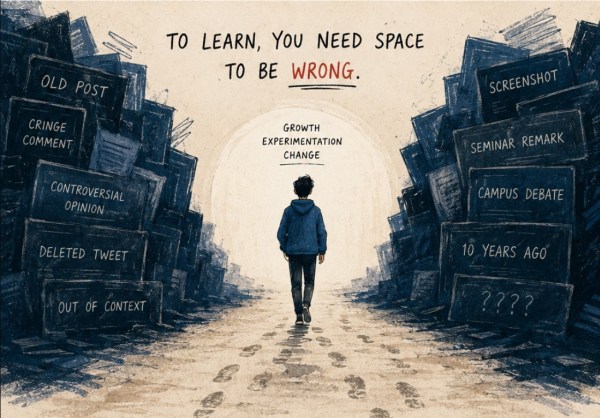 Protecting freedom of expression from external censorship is no longer the only challenge universities face
Digital campuses need digital privacy too
India’s higher education policy has embraced the digital university with remarkable confidence. Initiatives like SWAYAM under the National Education Policy (NEP) 2020 aim to improve access to education through technology.
But one question remains largely unanswered: what happens when the technologies that preserve knowledge also preserve every stage of learning indefinitely?
Neither the NEP nor the UGC distinguishes between preserving knowledge and preserving the messy process through which knowledge is created. The policies celebrate digitisation but remain largely silent on its consequences for intellectual privacy.
A doctoral thesis deserves a permanent place in the scholarly record. A classroom disagreement does not.
Story continues below this ad
A peer-reviewed article serves a different purpose from a student magazine or a seminar discussion.
Good education depends on recognising these distinctions. Current policy does not.
Digitisation itself is not the problem. The challenge is ensuring that it does not undermine the exploratory nature of learning.
An education policy for the digital age cannot concern itself only with preserving knowledge. It must also protect the intellectual privacy that makes knowledge possible in the first place.
Story continues below this ad
The anxiety that led us to reconsider publishing that article was not an isolated incident. It reflected a broader shift in how knowledge is created, circulated and remembered.
Protecting freedom of expression from external censorship is no longer the only challenge universities face. They must also ask whether students still have the freedom to think aloud in an age that remembers every unfinished thought. Without those safeguards, universities risk producing cautious speakers instead of curious minds.
The article is co-authored by Maleeha Shafi (Yale mentored researcher) and Azhar Ahmad (political science graduate). Both authors are featured in the University of Chicago.























 English (US) ·
  French (CA) ·
  French (FR) ·