

 2 months ago
26
2 months ago
26
PROTECT YOURSELF with Orgo-Life® QUANTUM TECHNOLOGY
Orgo-Life the new way to the future Advertising by Adpathway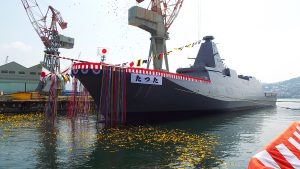
MHI launched Tatsuta, the eleventh Mogami-class frigate on order for the Japan Maritime Self-Defense Force, in a ceremony held at its facilities in Nagasaki, Japan, July 2, 2025.
Credit: Takahashi KosukeOn August 4, the Japanese Ministry of Defense published its annual 2026 Defense White Paper, which outlines Japan’s defense policies and activities. While the report extensively covers the increasingly severe security environment surrounding Japan, notable highlights include an emphasis on one of Japan’s core concepts, “new ways of defense,” and its defense production.
Notably, the White Paper follows Japanese Defense Minister Koizumi Shinjiro’s comment at the Farnborough International Airshow: “Defense production is deterrence itself. No matter how advanced a defense system may be, it means little if it cannot be produced.” His statement suggests a fundamental shift in how Japan views deterrence: rather than mere possession of defense materiel, Japan increasingly recognizes the importance of the defense industrial base as a source of strategic capability.
Japan, like other countries around the world, is learning from Russia’s full-scale invasion of Ukraine. Some of the takeaways include the decisive role played by unmanned assets, renewed appreciation for strong air defense, and the importance of sustaining a defense industrial base that can keep up with a protracted war. Furthermore, recent conflict in the Middle East and concerns about diminishing U.S. stockpiles have sparked concern among U.S. allies about the reliability of the United States as a supplier of advanced munitions for their militaries. These conflicts have served as critical turning points in Japan’s defense posture, prompting the Japanese government to rethink its defense policies to invest more in developing indigenous capabilities and partner with other U.S. allies that share similar concerns.
Prime Minister Takaichi Sanae’s administration is expected to complete the revision of Japan’s three key security documents by the end of 2026. The updates are anticipated to reorient Japan’s national security strategy to better respond to the aggravating regional security environment, integrate new capabilities with strengthened alliances and partnerships, and develop greater self-reliance. Takaichi has already made notable progress in strengthening Japan’s security posture, including the relaxation of the Implementation Guidelines for the Three Principles on Transfer of Defense Equipment and Technology, lifting a long-standing ban on lethal weapons exports.
The revision, which opened the door for Japan to export lethal weapons to 17 countries that have signed the Equipment and Technology Transfer Agreements (ETTAs), was done with the goal of strengthening Japan’s relations with its allies while contributing to the country’s economic growth through a stronger defense industrial base. Japan has already signed a $7 billion contract with Australia to deliver Mogami-class frigates beginning in 2029 and begun discussions with the government of the Philippines to export Type 88 surface-to-ship missiles. While visiting Singapore to attend the Shangri-La Dialogue in May, Koizumi also engaged in the discussion of the potential sale of Mogami-class frigates with his New Zealand counterpart.
With the new guidelines, Japan will be able to export weapons that were developed under joint production to third countries. That includes the Global Combat Air Program (GCAP) – the trilateral six-generation fighter development program that unites Japan, Italy, and the United Kingdom. Now, Canada has joined the GCAP as an observer.
However, as the Defense White Paper points out, there are multiple factors that Japan must improve to build a strong indigenous industrial base. For example, to ensure efficient production of domestic defense capabilities, Japan must shore up its supply chain resilience. Like other countries around the world, Japan is vulnerable to critical material shortages due to global conflicts and restrictions placed by countries. Japan also needs to improve its manufacturing efficiency and strengthen its cybersecurity. Finally, Japan will need to maintain business management and training personnel in the defense industry. This is a significant challenge for Japan, which is experiencing labor shortages due to its aging society.
In addition, Japan faces challenges with companies reducing their defense business or withdrawing from the defense market altogether. The Ministry of Defense and the Japanese government must make defense production more attractive to companies so that they can strengthen production.
With a stronger defense industrial base, Japan can increase its autonomy and also contribute to greater alliance relationship building with the United States and key partners. The ambitious goals that Japan has set require more than just an increase in defense spending, however. Ultimately, without the basic requirement of having enough companies and labor involved in defense production, Tokyo’s long-term goal will be impossible to reach.
As Japan continues to revise its key security documents, it is critical that the Japanese government and Ministry of Defense realistically assess their industrial capabilities and maintain a long-term focus and commitment to strengthening and sustaining its defense industrial base.


















 English (US) ·
  French (CA) ·
  French (FR) ·