

.png) 1 month ago
10
1 month ago
10
PROTECT YOURSELF with Orgo-Life® QUANTUM TECHNOLOGY
Orgo-Life the new way to the future Advertising by Adpathway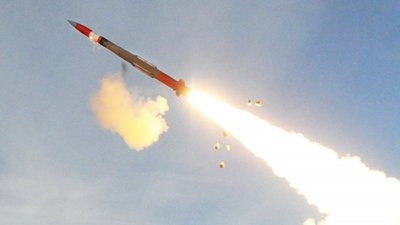
A PAC-3 MSE variant of the Patriot missile being fired at a test range. (image credit: Lockheed MArtin)
The United States military is pressed for key weapon systems as stockpiles dwindle due to extensive use in the ongoing conflict in Iran as well as support to Ukraine. The US Department of War has now urged the country's defence manufacturers to find ways to accelerate weapons delivery.
The department aims to create what it has dubbed 'Arsenal of Freedom', which involves improving supply chains, providing long-lead funding, lowering costs and increasing competition.The US Department of War’s new acquisition strategy aims to set the stage for a sweeping overhaul in defence production. It aims to provide long-term stability and encourage industry to invest in expanding its capacity. Lockheed Martin has emerged as the first mover under this initiative, announcing a landmark framework agreement to accelerate weapons output.
Central to this commitment is the tripling of production capacity for the PAC-3 Missile Segment Enhancement (MSE) interceptor and a fourfold increase in Terminal High-Altitude Area Defense (THAAD) interceptors, which are in high demand both in West Asia and in Ukraine.
Iran Scores First Hit On US Aircraft After Trump's War Pause? 'Direct Hit' Claim Near Hormuz
Lockheed Martin's CEO called the step a “landmark framework” that would boost production of the PAC-3 MSE interceptors fired by the Patriot system.
These advanced air defence missiles are designed to neutralise tactical ballistic missiles, cruise missiles, drones and aircraft. The company’s Missiles and Fire Control division is investing heavily in facilities to meet surging demand, reflecting the growing importance of missile defence in contemporary warfare.
Alongside PAC-3 and THAAD, production of the Precision Strike Missile (PrSM) is also being quadrupled.The US government backed this acceleration with a $4.7-billion undefinitized contract action (UCA) for PAC-3 MSE in April 2026, building on a framework signed earlier in January. A separate $4.94-billion award supports PrSM production. Lockheed Martin is also scaling up output of the AGM-158 Joint Air-to-Surface Standoff Missile (JASSM), the AGM-158C Long-Range Anti-Ship Missile (LRASM), and expects similar expansion for the AGM-179 Joint Air-to-Ground Missile (JAGM) and the Javelin anti-armor weapon.
These systems are increasingly integrated into joint operations, with PAC-3 and THAAD linked to the US Army’s Integrated Air and Missile Defense Battle Command System and tested alongside the F-35 stealth fighter.Traditionally, the manufacturing cycle for advanced interceptors like PAC-3 MSE has stretched up to three years from contract to delivery. The aim now is to compress this timeline significantly, due to the urgency to replenish dwindling stockpiles.























 English (US) ·
  French (CA) ·
  French (FR) ·