

PROTECT YOURSELF with Orgo-Life® QUANTUM TECHNOLOGY
Orgo-Life the new way to the future Advertising by Adpathway A new AI tool can read hidden signatures of aging from ordinary microscopy images of blood-forming stem cells. Credit: Shutterstock
Researchers have developed an AI system that can detect subtle, age-related changes in the three-dimensional organization of DNA inside mouse blood stem cells.
As we grow older, our bodies gradually become less able to produce an adequate supply of blood cells. This decline affects the hematopoietic system, the network of organs and tissues responsible for blood production. Finding ways to preserve or restore its function requires understanding how blood-forming stem cells age, but the physical changes inside these cells can vary widely and remain too subtle to recognize under a microscope.
Researchers have developed an artificial intelligence tool called ChromAgeNet to help detect those changes. It examines three-dimensional images of a cell’s nucleus, looking for patterns in how DNA is organized. In a study of mouse blood stem cells published in Aging Cell, the model showed a 77% probability of correctly distinguishing young cells from aged ones.
The work was led by Dr. Maria Carolina Florian, a researcher in the Regenerative Medicine Program at Bellvitge Biomedical Research Institute (IDIBELL) and an ICREA Research Professor, and Dr. Paula Petrone, a researcher at the Barcelona Supercomputing Center–Centro Nacional de Supercomputación (BSC-CNS) and the Barcelona Institute for Global Health (ISGlobal).
Younger DNA patterns do not prove rejuvenation
Recognizing age-associated patterns could give researchers a way to assess treatments intended to change them. As a proof of concept, the team applied ChromAgeNet to aged blood stem cells treated with different epigenetic drugs, which act on mechanisms that regulate gene activity.
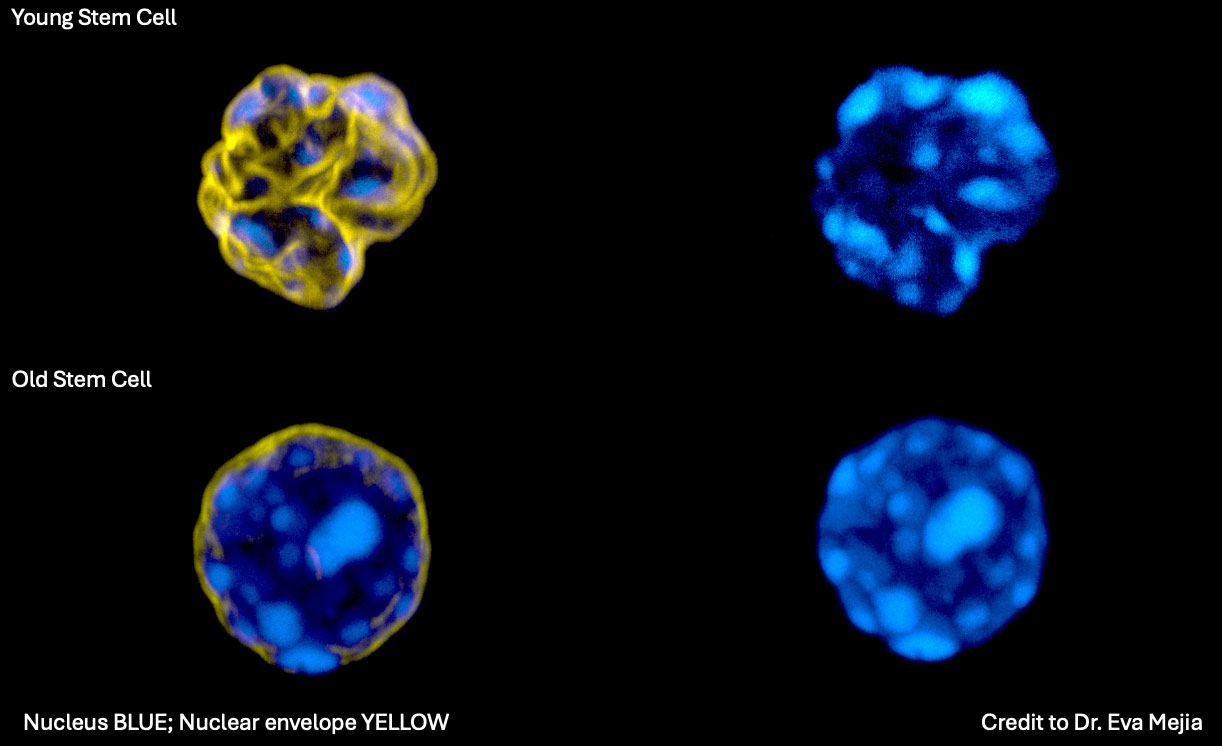 Aged and young stem cells distinguished thanks to chromatin architecture analysis by ChromAgeNet. Credit: Dr. Eva Mejía / IDIBELL
They used the model to assess whether the treatments shifted DNA organization toward a pattern consistent with younger cells. The results demonstrate the tool’s potential for detecting responses to interventions, but they do not establish that the drugs restored the cells’ function or rejuvenated them.
Reading age in DNA’s arrangement
Inside the nucleus, DNA is packaged into chromatin, a material made mainly of DNA and proteins. Its organization helps regulate which genes are active, shaping a cell’s identity and function. Studying that arrangement gives researchers a way to investigate aging through the physical architecture of the nucleus.
To develop ChromAgeNet, the team collected three-dimensional images of mouse hematopoietic stem cell nuclei stained with DAPI, a widely used technique for making DNA visible. A convolutional neural network, a type of AI designed to analyze images, learned to distinguish young cells from aged ones. It performed better than a separate machine learning model that relied on chromatin features the researchers had defined beforehand.
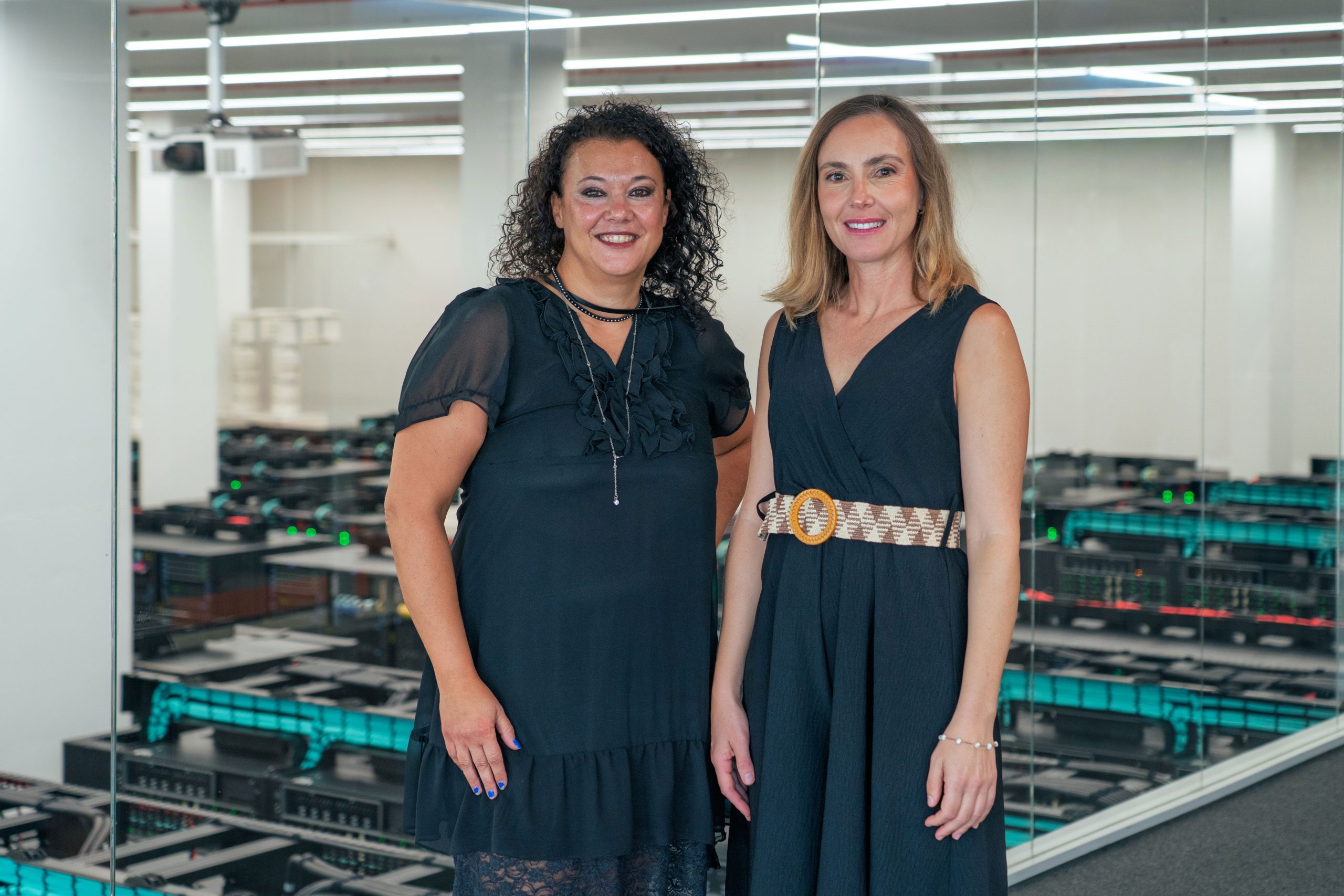 Drs Maria Carolina Florian (IDIBELL, left) and Paula Petrone (BSC-ISGlobal, right), coleaders of this research. Credit: Mario Ejarque (BSC-CNS)
The researchers also examined which features of the images helped ChromAgeNet make its predictions. Among them were chromatin entropy, a measure of disorder, and heterochromatin, a tightly packed form of chromatin, near the edge of the nucleus. Certain chromatin condensates, concentrated assemblies of chromatin material, also helped distinguish age-associated states. Rather than relying on an obvious visual difference, the model identified combinations of spatial features that carried information about cellular aging.
Knowing which features contribute to a prediction connects the model’s classifications to specific characteristics of nuclear architecture. This approach could complement other aging biomarkers, including epigenetic clocks, which estimate biological age from chemical changes to DNA, such as changes in methylation.
A common stain could expand drug screening
Using the tool to screen large numbers of compounds could become practical because DAPI is inexpensive and easy to incorporate into microscopy protocols. ChromAgeNet also has relatively few model parameters, the internal values it learns during training. These characteristics could support its use in high-throughput microscopy, where large quantities of samples are analyzed, and help researchers identify compounds worth investigating as potential rejuvenation treatments.
The project formed a central part of ISGlobal researcher Pablo Iañez’s doctoral thesis and combined expertise in stem cell biology, aging, image analysis, and artificial intelligence. The team has made ChromAgeNet available to the scientific community alongside a dataset of three-dimensional images of hematopoietic stem cells. Few imaging datasets for studying the aging of these cells are publicly available, and the resource could help other researchers develop and validate computational tools.
Reference: “Deep Learning Predicts Hematopoietic Stem Cell Aging From 3D Chromatin Images” by Pablo Iáñez Picazo, Eva Mejía-Ramírez, Dario Di Bari, Elena Vitali, Maria Carolina Florian and Paula Petrone, 27 September 2026, Aging Cell.
DOI: 10.1111/acel.70656
Funding: European Research Council (ERC) grant 101002453 (M.C.F.), Spanish Ministry of Science, Innovation and University grants RYC2018-025979-I (M.C.F.), PGC2018-102049-B-I00 (M.C.F.), CNS2023-144908 (M.C.F.), and PID2021-123922NB-I00 (M.C.F.), the grant CEX2023-0001290-S funded by MCIN/AEI/10.13039/501100011033, and support from the Generalitat de Catalunya through the CERCA Program (P.P.), and INPhINIT Incoming fellowship from “la Caixa” Foundation (ID 100010434) with code LCF/BQ/DI22/11940001 (P.I.P.). P.P. received a fellowship within the “Generación D” initiative, Ministerio para la Transformación Digital y de la Función Pública, for talent attraction (C005/24-ED CV1), funded by the European Union NextGenerationEU funds, through PRTR.
Never miss a breakthrough: Join the SciTechDaily newsletter.
Follow us on Google and Google News.

















 English (US) ·
  French (CA) ·
  French (FR) ·