

PROTECT YOURSELF with Orgo-Life® QUANTUM TECHNOLOGY
Orgo-Life the new way to the future Advertising by Adpathway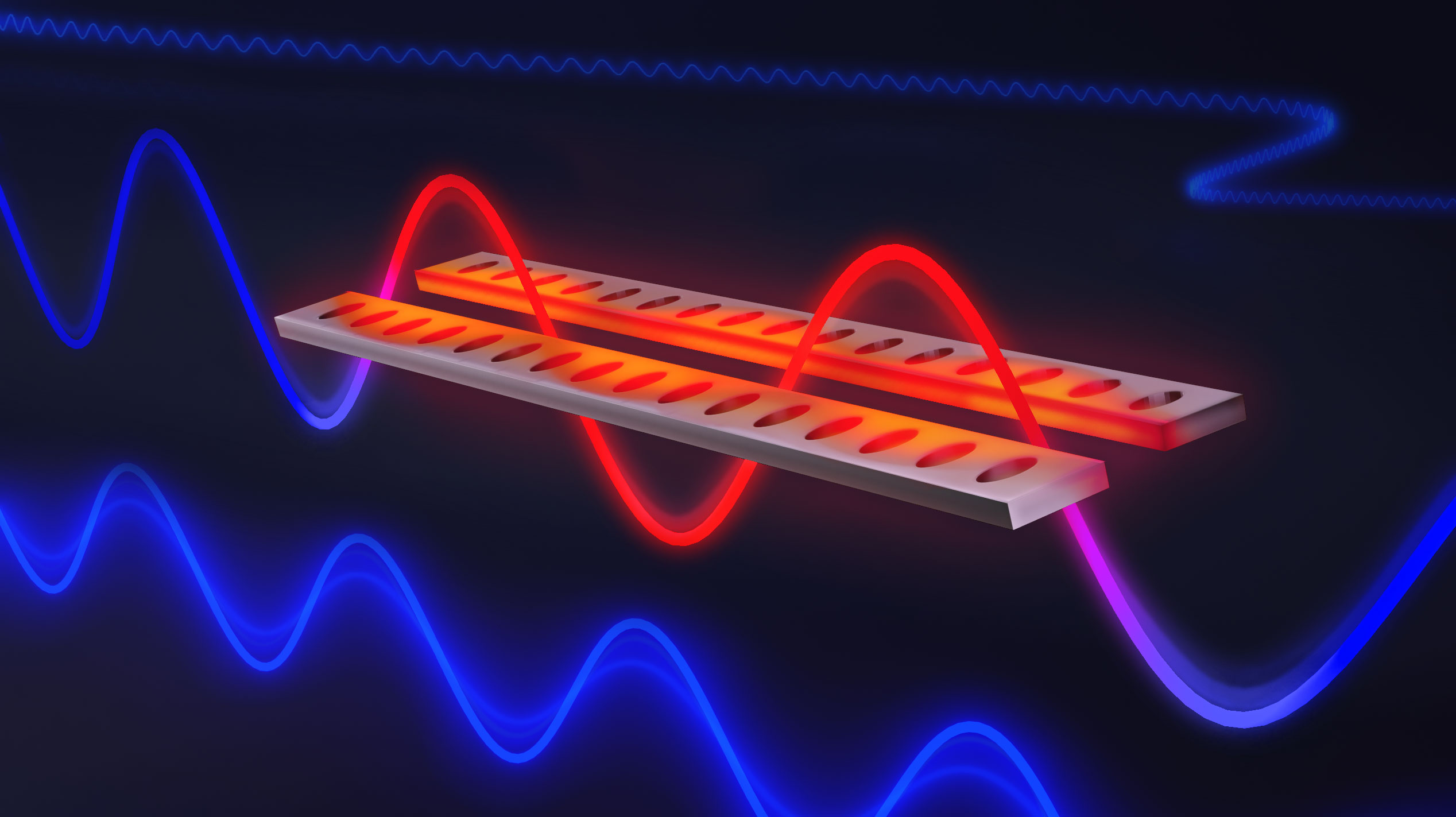 State-of-the-art nano-strings have vanishingly small internal friction and record-low thermal noise. They are now so sensitive that they can feel friction from nearby objects — without ever making contact. Credit: Paresa Arabmoheghi 2026 EPFL
Nanomechanical resonators are vital to precision sensing and emerging quantum technologies, but their extraordinary sensitivity comes with an unexpected vulnerability.
A nanomechanical device can lose much of its ability to sustain vibrations without ever touching another object. Researchers at EPFL have discovered that placing insulating materials just a few hundred nanometers from these tiny structures can dramatically increase energy loss, reducing their mechanical quality factor by as much as tenfold.
The findings, published in Nature Physics by scientists in the group of Tobias J. Kippenberg, identify a previously underappreciated limitation for ultrahigh-precision sensors and quantum technologies. The source of the problem is an electrical interaction that allows energy to escape across an otherwise empty gap.
How Vibrations Lose Energy Without Physical Contact
The mechanism begins with static electric charges trapped inside a mechanical resonator. As the structure vibrates, those charges move with it, producing a changing electric field in the surrounding space. When an insulating material such as silicon dioxide or silicon nitride is nearby, the fluctuating field interacts with the material and causes energy to dissipate through its small electrical losses.
This process is related to “noncontact friction,” a phenomenon previously observed in atomic force microscopy. Although the surfaces never touch, mechanical energy is transferred away from the vibrating structure. The resulting damping lowers its quality factor, which measures how efficiently a resonator stores vibrational energy rather than losing it.
Experiments Reveal a Strong Dependence on Distance and Frequency
The researchers developed a theoretical model predicting that lower-frequency vibrations would experience greater energy losses. To test this, they studied silicon nitride strings suspended approximately 500 nanometers (0.00002 inches) above a dielectric layer. By measuring how quickly different vibrational modes decayed, they confirmed that the lowest-frequency modes suffered the strongest additional damping, consistent with the model.
A second experiment examined resonators designed for exceptionally high quality factors. The team positioned vibrating strings between photonic crystal cavities, with separations of only a few hundred nanometers (roughly 0.00001 inches). As the gaps narrowed, the quality factor declined sharply, sometimes falling by a factor of ten. The researchers also demonstrated that their modeling approach could reproduce the effects of trapped charges in these more complicated device geometries.
Implications for Quantum Technology and Precision Sensors
Nanomechanical resonators are microscopic vibrating components fabricated on chips, operating at frequencies from a few kilohertz to several gigahertz. Their sensitivity makes them useful for detecting extremely small changes in mass, force, temperature, and pressure. They also serve as components in radiofrequency filters and chip-based clocks. Advanced versions can even be used to prepare quantum states of comparatively large mechanical objects and investigate fundamental physics.
Many of these applications require resonators to operate extremely close to other structures, particularly when measuring motion or coupling mechanical vibrations to light and electrical systems. The EPFL results show that trapped charges and dielectric losses must be considered when designing such closely integrated devices, even when no physical contact occurs.
The same interaction could also have practical uses. By measuring how mechanical vibrations lose energy near insulating surfaces, researchers may be able to characterize electrical losses in thin films or develop controlled interactions between mechanical resonators and other electrical systems. Understanding these effects could help engineers preserve mechanical coherence while integrating increasingly sensitive resonators into complex quantum and sensing devices.
Reference: “Non-contact friction in ultracoherent nanomechanical resonators near dielectric materials” by Amirali Arabmoheghi, Alessio Zicoschi, Guillermo Arregui, Mohammad J. Bereyhi, Yi Xia, Nils J. Engelsen and Tobias J. Kippenberg, 7 July 2026, Nature Physics.
DOI: 10.1038/s41567-026-03350-z
Funding: Swiss National Science Foundation (SNSF)
Never miss a breakthrough: Join the SciTechDaily newsletter.
Follow us on Google and Google News.





















 English (US) ·
 French (CA) ·
 French (FR) ·