

 1 month ago
59
1 month ago
59
PROTECT YOURSELF with Orgo-Life® QUANTUM TECHNOLOGY
Orgo-Life the new way to the future Advertising by AdpathwayMost local businesses do not need another spreadsheet of generic directories. They need links that make sense for the business, its location, and the people it serves. Many strong local link sources are already nearby: an overlooked council directory, an incomplete supplier profile, or a community event that never linked back.
You can open Table of Contents show
Google describes local ranking in terms of relevance, distance, and how well known a business is. Links from other websites are one input in that prominence assessment, not a shortcut around the other factors. The order is practical, not a quality ranking: it moves from structured listings that are relatively easy to verify to editorial and partnership links that require a genuine reason to exist.
Before Hunting for Local Link Sources
A local backlink should pass a simple test: would the page still be useful without search rankings? A council supplier directory, chamber profile, or newspaper story can help residents discover a business. A directory containing thousands of unrelated companies and no visible local audience usually cannot.
Before investing time or money, check four things:
- The page is public and maintained.
- The organization genuinely serves the city or district.
- Business profiles contain working website links.
- Residents have a reason to use the page.
A respectable name does not rescue a directory full of expired profiles and broken links. A link marked nofollow or sponsored generally should not be treated as ranking credit, although it may still send visitors and reinforce local recognition.
Earning a mention through membership, participation, or useful information differs from paying solely for ranking credit. Google treats unqualified paid links, excessive exchanges, automated link creation, and low-quality directory links intended to influence rankings as link spam. Advertising and sponsorship links are permitted when publishers label them appropriately. If a relationship has no value without a followed backlink, it is probably the wrong prospect.
9 Local Link Sources Worth Checking
The best local link opportunities are not always the most obvious. Some require a simple profile correction, while others depend on genuine participation, useful information, or an existing business relationship. These nine sources are worth checking because they can improve local visibility without relying on mass outreach or low-quality directories.
1. Chambers of Commerce and Business Associations
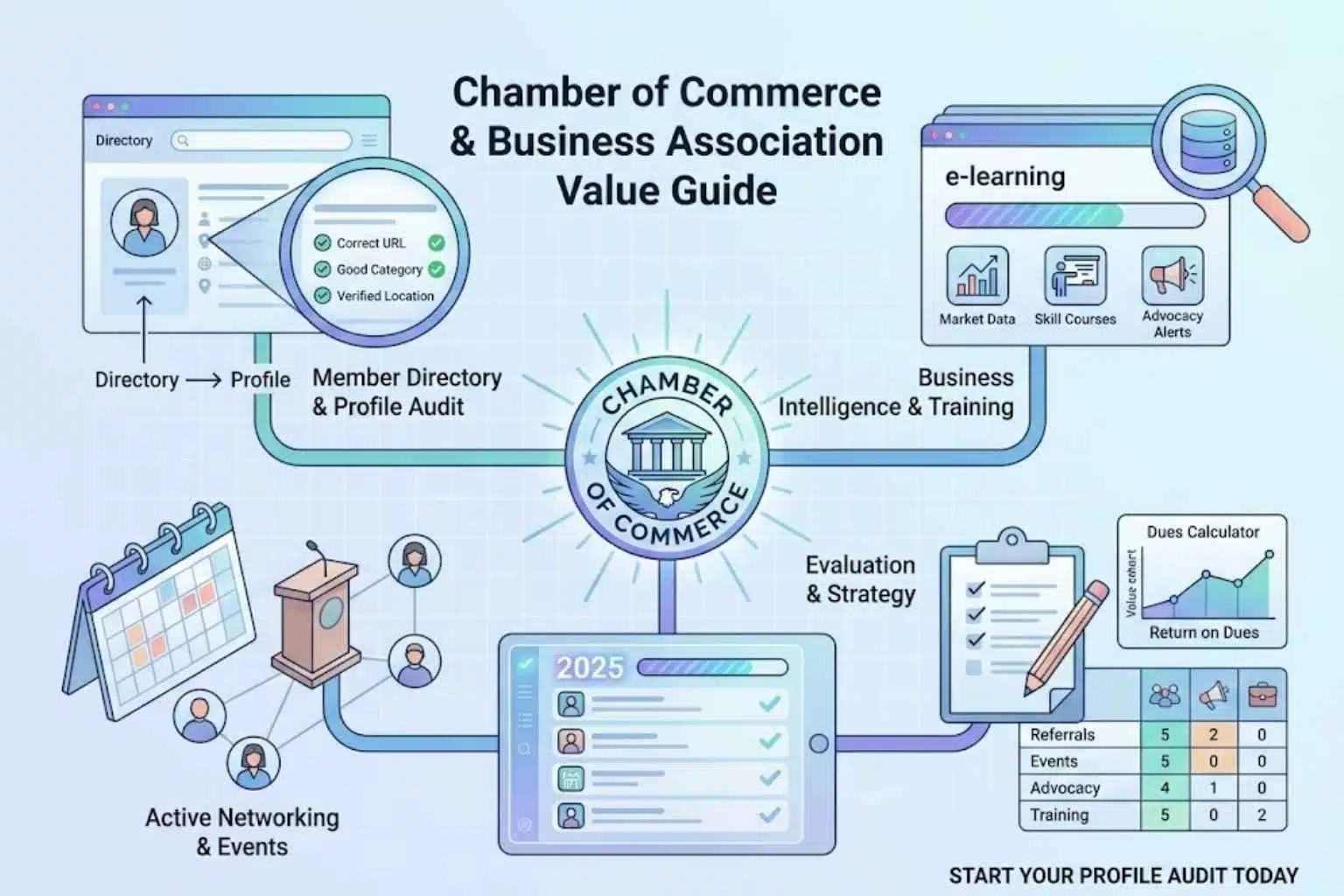
Chambers are the most obvious option on this list, yet many businesses join one and never complete their online profile. Local chambers commonly maintain searchable member directories organized by business type. Some also publish member news, event recaps, interviews, and sponsor pages. Existing members should check here first because eligibility is already established.
Before paying dues, inspect the actual directory. Confirm that profiles are public, website links work, and entries appear to be maintained. Then judge the wider membership value: referrals, events, advocacy, or training. Joining solely for one link is difficult to justify if the organization has little activity or relevance.
Begin with a basic profile audit today. Search the online directory for the business name and correct an old URL, weak description, wrong category, or missing location.
2. Municipal and Economic Development Directories
City councils, municipal authorities, and economic development teams sometimes run local business, supplier, tourism, or “shop local” directories. These are among the most overlooked local link sources because they are rarely marketed as SEO opportunities.
Eligibility can be strict. A directory may require a registered address in the municipality, a local business registration number, or evidence that the company can supply public-sector contractors. Those rules help prevent the directory from becoming another generic business database.
Search for combinations such as “city business directory,” “council supplier directory,” and “economic development business register.” Use the official application route, provide accurate details, and do not create a fake location to qualify. Also check what inclusion actually means. Kingston Council, for example, states that businesses in its supplier directory have not been assessed and that a listing does not guarantee work. Some directories show only a name, address, and category rather than a website link.
3. Downtown, Neighborhood, and Merchant Groups
A citywide chamber can be broad. A downtown association, business improvement district, market association, or neighborhood merchant group often has a tighter geographic focus and a more relevant local audience.
These groups may publish member directories, shopping guides, maps, seasonal campaigns, and event pages. They are particularly useful for retailers, restaurants, clinics, venues, and other businesses tied to a physical district. A service-area company located outside the boundary may not qualify, and forcing the connection is not worth it.
Look beyond the main directory. A holiday guide, accessibility map, late-opening list, or district event page may provide a more useful mention if the business genuinely belongs there.
4. Local Newspapers and Community Publications
Local media links are harder to earn because a business existing is not news. A generic press release about “excellent service” gives an editor almost nothing to work with.
Useful pitches have a local consequence. That might be a new facility filling a service gap, responsibly aggregated data showing a change in local demand, guidance tied to a city problem, or a community initiative with named partners and documented results. Send the story to the journalist who covers the subject, not every address on the masthead.
A workable pitch needs a one-sentence local angle, evidence an editor can check, and a contact available for questions. Include relevant photographs only when the business has permission to publish them.
Do not make a backlink a condition of coverage. An editor may link to a useful report or event page, mention only the brand, or omit the link altogether. The business earns better coverage by supplying verifiable details, a concise local angle, and a contact who can answer follow-up questions promptly.
5. Event Organizers, Festivals, and Public Calendars
Hosting, speaking at, supplying, or sponsoring a real local event can create several natural mentions: the organizer’s partner page, a venue listing, a municipal calendar, and post-event coverage. The strongest destination is usually a useful page on the business website with dates, access details, booking information, or original event material.
Do not submit ordinary promotions as community events. Calendar managers may reject sales-led listings, and links added by users may be qualified as ugc or nofollow, routed through a redirect, or removed when the event expires. Inspect the actual platform instead of assuming its links pass ranking credit. Treat attendance and local visibility as the primary return.
6. Nonprofits and Civic Causes
Community organizations need volunteers, venues, professional skills, equipment, and publicity as well as money. A business that contributes something genuinely useful may be acknowledged on a partner page, annual campaign page, or project report.
The cause should fit the company and community. A veterinary clinic supporting an adoption event makes sense; an unrelated donation made only to obtain a backlink looks transactional. Ask what the organization needs before proposing a contribution, and never pressure a small nonprofit to change its website for SEO purposes.
Where money or goods are exchanged for exposure, the publisher should qualify the resulting link. Google recommends rel=”sponsored” for paid placements and still accepts nofollow. Do not negotiate for a followed link as part of the donation. Sponsorship needs to stand on its community and brand value even when it provides no direct ranking benefit.
7. Schools, Colleges, and Libraries
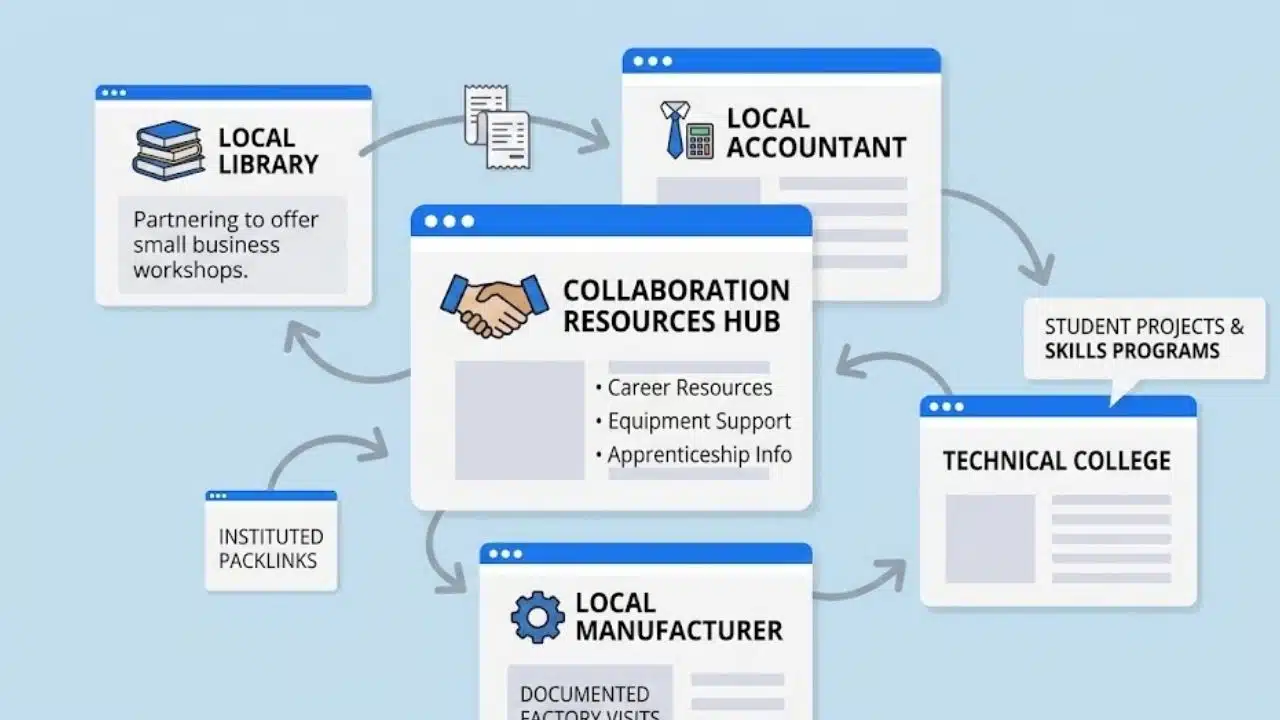
Educational websites are often treated as an SEO shortcut. They are not. The useful opportunities come from real collaboration: internships, apprenticeship information, public workshops, student projects, career resources, equipment support, or participation in a college foundation program.
A local accountant might help a library run a basic bookkeeping session for new businesses. A manufacturer could offer a documented factory visit or skills program through a technical college. If the institution publishes a resource, partner, or event page, a business link can help readers act on the information.
Skip “scholarship link building” created mainly to collect university links. It adds administrative work, encourages transactional outreach, and loses its educational purpose when the award exists only for SEO.
8. Suppliers, Distributors, and Complementary Businesses
Some of the easiest wins sit inside relationships the company already has. Manufacturers maintain dealer and installer locators. Distributors list stockists. Professional bodies publish certified-provider directories. Suppliers write customer stories, while complementary businesses maintain trusted-resource pages.
Audit these first. A missing website link or outdated profile is easier to fix than a cold pitch is to win. For a new opportunity, suggest something useful to both audiences, such as a detailed case study, maintenance guide, project breakdown, or joint local event.
Avoid turning every relationship into “link to us and we will link to you.” Occasional, relevant cross-references are normal. Large partner pages created only to exchange links are exactly the pattern Google warns about.
9. Commercial Properties, Markets, and Coworking Spaces
Shopping centers, food halls, public markets, office buildings, and some coworking spaces maintain tenant or vendor directories. Businesses pay attention to the lease or stall agreement and forget the website attached to the property.
Check whether the listing points to the correct location page rather than a generic homepage. A restaurant inside a food hall should give visitors menus, hours, and directions for that branch. A consultant using a coworking space should confirm that public promotion is included and that the listing does not imply a staffed office that customers cannot visit.
This source is narrow but practical. If the business has a legitimate on-site presence, the property or market directory may be one of the clearest explanations of where it operates. Do not assume every profile includes an external link; verify the published format first.
A 30-Minute Local Link Audit
Start with a relationship inventory rather than a backlink tool. Write down the organizations the business already pays, supplies, supports, rents from, belongs to, or collaborates with. For each one, search its website for terms such as “members,” “partners,” “vendors,” “directory,” and “sponsors.”
Record four details for each organization:
- Whether the business is eligible
- Whether a profile or mention already exists
- Whether it points to the correct destination URL
- Whether participation has value beyond SEO
Fixing an incomplete member or supplier profile should come before pitching a stranger.
For new outreach, send the official business name, a factual description, the most relevant page, contact details, and eligibility evidence. A branded link to a useful location or service page is more natural than an exact-match keyword anchor.
A Simple Way to Start
Start with five existing relationships this week, not 50 cold prospects. Check a membership, supplier, property or market, community organization, and event or institution connected to the business. Correct inaccurate profiles before making new pitches. It is less glamorous than mass outreach, but it usually produces better conversations and fewer wasted emails.
Then choose two or three local link sources that offer value beyond rankings. A directory should help customers find the business, a media pitch should inform the city, and a partnership should benefit the participants. When the relationship is real and the page serves a local audience, the link has a sound reason to exist.
Final Thoughts
Good local link building rarely starts with strangers. Begin with organizations that already know your business, such as chambers, suppliers, property managers, event organizers, and community partners. Check existing profiles, correct broken URLs, and pursue only opportunities that help local readers. The most valuable local link sources are credible pages that explain who you are, where you operate, and why someone nearby should care. Build the local relationship first, and let the backlink follow naturally.
















 English (US) ·
  French (CA) ·
  French (FR) ·