

PROTECT YOURSELF with Orgo-Life® QUANTUM TECHNOLOGY
Orgo-Life the new way to the future Advertising by AdpathwayOur fivesome of fantastic reviews this week includes, Zain Khalid on Ayad Akhtar’s The Radiance, Franklin Schneider on MrBeast and James Patterson’s The Most Dangerous Games, Jason Mott on T. Geronimo Johnson’s The Occidental Book of the Dead, Sam Worley on Barbara Kingsolver’s Partita, and Joe Moran on Sarah Perry’s Death of an Ordinary Man.
Article continues after advertisement
Brought to you by Book Marks, Lit Hub’s home for book reviews.
*
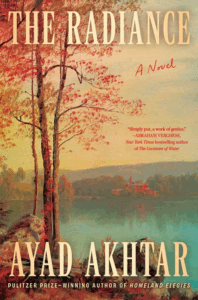
“Diagnosis is the campus novel’s reigning temptation. The university offers the novelist a prefabricated sociology: different generations, classes, ideologies, and institutions conveniently compressed in vitro, in seminar rooms, where everyone can be assigned a representative grievance before being permitted the inconvenience of ambiguity or personhood. Ayad Akhtar’s new novel, The Radiance, sometimes succumbs to this temptation. Its students arrive morally outraged, a priori puritans, while its professors are enervated and dissatisfied. Its narrator, however, has suffered an accident no one can adequately explain, least of all the author. Whenever the novel returns to his damaged body and escapes campus life, it becomes beautifully quixotic.
…
“The problem is not that Title IX is unworthy of fiction. Bureaucracy can be one of fiction’s great subjects. Kafka got quite a bit of mileage out of paperwork. But bureaucracy requires transformation: comedy, terror, absurdity, erotic charge, something that imbues institutional language with human life. The Radiance occasionally reproduces the exhausting proceduralism it means to examine. The reader takes on the role of a defendant in an HR investigation, obliged to absorb every detail. His effigy of Gen Z clashes with much of what has emerged in recent years. For example, the student journalists at The Cornell Daily Sun whose reporting on an alleged gang rape and demands for institutional accountability offer a bracing corrective to Akhtar’s portrait. In reality, these students can properly scrutinize their universities, which, much like Akhtar’s narrator, perceives them solely as threats or clients. Conversely, the narrator’s body keeps supplying experiences that resist any adjudication. The tension between intellectual certainty and its corporeal obverse is the novel’s most interesting possibility, yet its campus plot repeatedly narrows into a question of who deserves our sympathy. Maybe no one, but probably everyone.
…
“There is something dispiritingly secondhand about all this. Anyone who has taught undergraduates or read a piece in a magazine like this one, during the period the novel describes, will recognize the caricature: the phones, the therapeutic vocabulary, the sometimes comical inflation of minor discomfort into existential grievance. The contemporary campus has generated so much discourse about itself that fictional students arrive pre-pilloried. Akhtar seems aware of the problem but can’t always escape it. His students are exhibits in an ethnographic museum.
…
“Perhaps this is why the novel’s account of convalescence lingers after much of its campus material has faded. Akhtar has written a book obsessed with interpretation, populated by professors, students, doctors, lawyers, and writers committed by profession to meaning-making. But the damaged body keeps interrupting their explanations. It glows, goes numb, divides itself in two, loses desire, recovers it differently. Akhtar so tenderly renders the beauty and ennui of being unsure of one’s own psyche and soma that I return to those passages regularly.”
–Zain Khalid on Ayad Akhtar’s The Radiance (Vulture)
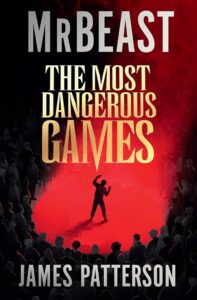
“The Most Dangerous Games does have one modest twist on the form of a novel: Readers gain a chance to enter a real-life $1 million competition by solving puzzles that drop each week on the book’s website. Getting answers requires hunting for clues scattered throughout the text; for example, looking for differences in images on the book’s website and illustrations in the book, or using certain page numbers as map coordinates. (Nothing projects confidence in a book like offering people a chance at a big check if they complete it.)
Donaldson seems to think that the story itself, and not just the puzzle, will propel readers toward the end; he has compared the book to The Odyssey. Considering that both authors are innovators of highly consumable brain rot in different mediums, the book is an old-fashioned dud. Most Dangerous alternates between tersely described physical action and what I’d describe as free indirect whining (‘This isn’t a dream. This is a nightmare.’). There are undigested chunks of clumsy characterization (‘He wants to help people. He wants people to count on him again.’), clichéd trauma background (control-freakish behavior is blamed on a ‘mother’s depression’), and dialogue that tries to be quippy but comes off as tired (‘I’ve got a better idea.’ ‘What’s that, mate?’ ‘You can kiss my ass.’). I’m not sure that the tween demographic, conditioned by short-form video and stroboscopic editing, will be eager to read 480 pages of this, even with the million-dollar jackpot on the line.
…
“Placing most of the blame on Patterson here is tempting, as the written word is his domain. Zooming out, though, the book’s execution seems to reflect a generational shift toward the contemporary MrBeastian ‘Platform is everything’ ethos over Patterson’s 20th-century ‘Give the people what they want’ worldview. By putting out a book that skimps on many of the ultra-processed qualities that led Patterson and Donaldson to mass success, the authors seem to be betting that the reason so many Americans don’t buy books anymore is that they haven’t yet heard about them from their favorite YouTuber. In essence, The Most Dangerous Games is a gamble that the product doesn’t matter as much as the brand, that consumers buy the sizzle, not the steak.
In taking that gamble, the authors cheated fans and missed an opportunity. A significant portion of today’s teenagers are proactively limiting screen time in favor of offline living, and a book could have been a way for Donaldson’s audience to follow him even after they’ve logged off. When I asked a friend whether her 11-year-old son, Linden, liked MrBeast and had heard of the novel, she showed me a photo of his copy. But when I asked if he was enjoying it, she said that he thought the writing was ‘amateur’ and that he’d quit 100 pages in. For a while, she tried to solve the puzzles by herself; if her kid didn’t get much out of the book, she thought, she wanted to at least try for the cash. This week, though, she quit too. Some people, apparently, have limits on what they’re willing to do for a buck.”
–Franklin Schneider on MrBeast and James Patterson’s The Most Dangerous Games (The Atlantic)
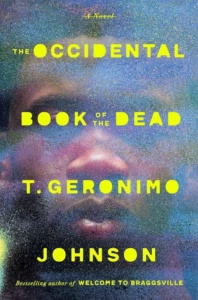
“The Occidental Book of the Dead, by T. Geronimo Johnson, is a strange book. In fact, it’s several strange books (an interior title page renames it ‘The Occidental Book[s] of the Dead’), as well as a TV show and a series of confessions and a radio broadcast, all wrapped in one big novel—though ‘a novel’ is crossed out on the cover and title page. The book is doing a lot, but for good reason: It wants to draw attention to the complicated reality of America’s racial, political and social failings, ranging from flawed policing to the challenge of living as an outsider in your own country. It’s an interesting song, so I decided to stop and listen.
…
“With so much going on, the novel seems like it’s peacocking, working very hard to show us how different it is. Readers’ tolerance for the book’s maneuvers will vary. Some of the twists land: the perspective shift of Book 2, for example, which changes the narrative we’ve just been told as it changes point of view. Others do not, such as the TV show conceit, which, though provocative in theory, will come across to many readers as functionally cosmetic. But even with occasional misfires, The Occidental Book of the Dead just might be something the literary world needs to see more of: It’s ambitious, creative and, most important of all, unapologetic.
…
“The Occidental Book of the Dead is an adrenaline-filled high-wire act. It’s funny when it needs to be, hard to track when it wants to be, and meticulously engineered at every moment. It is storytelling from a writer who knows the fundamentals of the craft well enough that he can break all the rules and still build a propulsive story. The end result is a sharp, unapologetic art-house novel full of gravitas, humor and heartbreaking revelations about the Black American experience and the thousand and one ways our nation can shatter Black souls. It will not be a novel for everyone. It doesn’t want to be. And that’s a large part of why it succeeds.”
–Jason Mott on T. Geronimo Johnson’s The Occidental Book of the Dead (The New York Times Book Review)
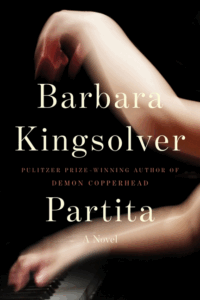
“This plot gives expression to an underlying theme of Kingsolver’s oeuvre: a small-c conservatism that locates social change at the level of the community or the family and that she supplements with a persistent antipathy toward big cities and the elites she imagines to live there. There’s an irony in this prominent liberal writer’s lack of interest in actual politics—in any kind of collective solidarity that might extend beyond the county line. The tendency lends Kingsolver’s work an inescapable feeling of asymmetry; she asks the biggest questions she can, then resolves them in the smallest ways possible. The foreclosing of any broader analysis, some system for contextualizing all these problems, risks shrinking this author’s well-founded objections into a laundry list of irritations—a problem that mars Partita, an unusually sour entry in the Kingsolver canon.
…
“Does it seem unfair to judge fiction on its political vision? Well, Barbara Kingsolver already let that horse out of the barn, and with each new novel she gives it a fresh shot of steroids and a sharp pat on the ass. Unsheltered intertwined two plots related to the precarity of American life and the danger of demagogues—one set at the dawn of the MAGA era. The threads are united by the single house where the protagonists live, which in both timelines is falling apart. If you haven’t detected the symbolic potential here, dialogue like ‘It’s the state of the union at our house. We’re a shambles’ will exhaustively establish it. This is not just a family drama: Kingsolver wants you to know she’s writing about the country. So it’s bizarre when the modern-day protagonists resolve their problems by realizing they can simply get rid of the house and move to Philly, where they find an apartment ‘with loads of antique charm’ in a walkable neighborhood. Built up as a novel of our current strife, the book fizzles into a sort of boomer bildungsroman. They just didn’t need all that stuff!
…
“What her characters lack in nuance they often make up for in theatricality. Partita demonstrates what happens to this first-person narrative technique when the personality isn’t there. Part of the problem is that it’s an awkward fusion of Kingsolver’s modes, a coming-of-age story Livia lugubriously recollects from the vantage of middle age, making the immediacy of her youthful feelings a harder sell. After her leftist boyfriend moved away to pursue union organizing, Livia suffered a series of tragedies that led her to drop out of college and return to her hometown. She inherited her father’s dairy farm and married a local boy.
…
“Kingsolver writes in some ways a fiction of naïveté, her métier being the primal experience of learning the world isn’t fair; this makes her, I suppose, the bard of a certain strain of American liberalism that exists in a constant state of befuddlement at all the problems but doesn’t have much more to say about them than that.”
–Sam Worley on Barbara Kingsolver’s Partita (Vulture)
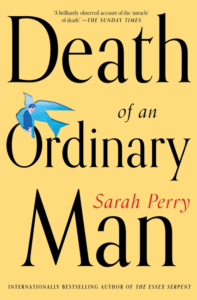
“It’s not easy to account for what makes this book so special. Its main character is as unpromisingly ordinary as its title suggests, and some may even find him a little boring. David Perry is the kind of man who spends hours sorting his beloved stamp collection into albums with the aid of long-tipped forceps and magnifying glasses, or filling in his Sudoku puzzle books, or reading the latest copy of the Antiques Gazette, looking intently at porcelain dogs and chased silver punch-bowls.
…
“Partly, this book works its magic through the adamantine detail and quiet lyricism with which it recounts a particular, unrepeatable life. David’s Davidness—always eating a bowl of cereal before bed, hoarding Wagon Wheels, calling his artificial sweeteners ‘depth charges,’ laughing with a half-private chuckle at his own bad jokes—comes off the page in sparks. The book perfectly catches a certain kind of clenched English male reserve, part shyness and part stubbornness. David only ever greets or says goodbye to his son with a handshake; they don’t even hug on the day he finds out he will die. He shows love, like many men of his generation, via punctiliousness, each January entering birthdays into a new wall calendar and then marking them with a tick once a card is sent. After his diagnosis he carefully writes, on the final page of this calendar, all his passwords and security details.
Mostly, though, what makes this book gem-like is that it succeeds in conveying the reality of death as this monumental, mythic thing that coexists surreally with the mundane world of council bin collections and neighbors hanging out their washing. Death, once it has decided to capture us, descends with the inevitability of gravity. Considering herself too sane for prophecies, Perry nonetheless notes that, as her father-in-law walked towards her shakily and confusedly in Norwich’s market square, she ‘knew immediately, with the cool and perfect certainty of arithmetic, that he was more or less a dead man.’ The 48 days he then takes to die make her see that ‘death has a duration and an amplitude, with events as various and strange as those of a life.’ Along the way, the book becomes about something else—the care gifted by strangers who arrive miraculously, via form filling and phone calls, and then vanish for ever.
…
“She watches David change hour by hour into someone else entirely, a diminished but more majestic self. Dying emerges as both ordinary, almost like an unpleasant chore to be negotiated, and unfathomably strange—’these things not cancelling each other out as they ought to have done, but persisting in undiminished quantities, like a failure of simple maths.’ As a young, aspiring writer, Perry yearned for dramatic, painful experiences to give her something to write about. She wanted, she says, ‘to hoard rubies and lose them, and spill ink into the loss.’ But here she has written beautifully and compellingly about the life of an unexceptional man, and an experience that is coming to all of us—and shown that there is no such thing as an ordinary life, or an ordinary death.”
–Joe Moran on Sarah Perry’s Death of an Ordinary Man (The Guardian)

















 English (US) ·
  French (CA) ·
  French (FR) ·