

PROTECT YOURSELF with Orgo-Life® QUANTUM TECHNOLOGY
Orgo-Life the new way to the future Advertising by Adpathway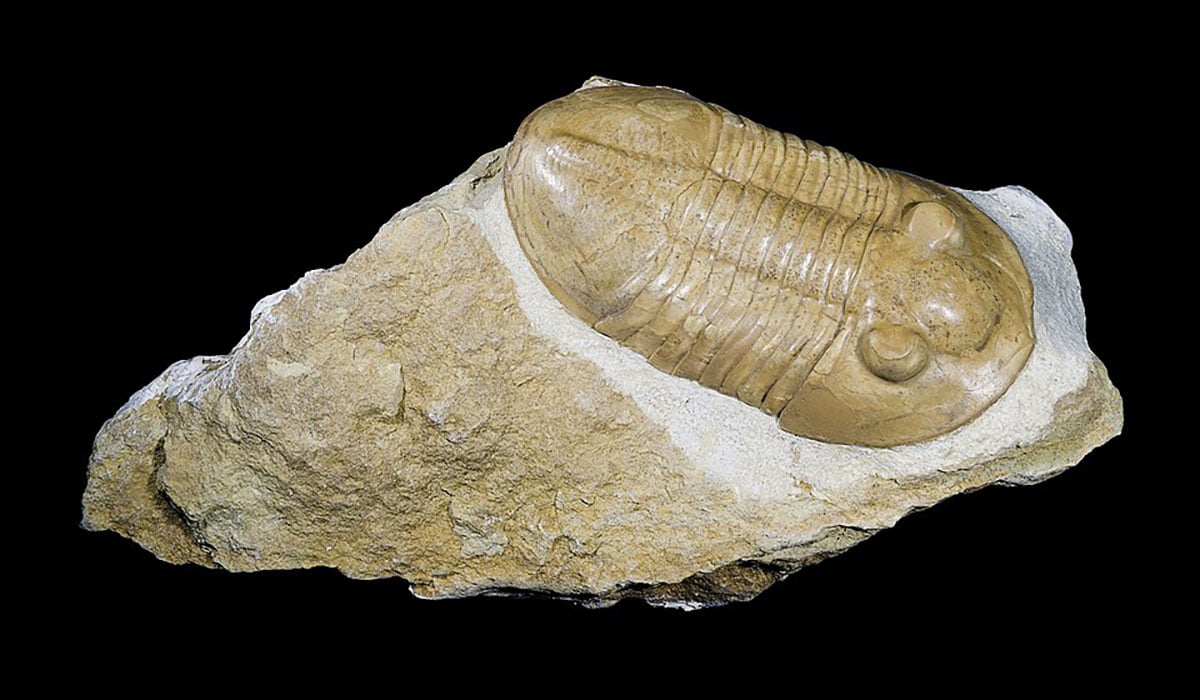 Trilobite, found in deposits of the Koporka river, Leningrad Oblast, Russia. Credit: Didier Descouens/Muséum de Toulouse
Ancient South African rocks reveal how phosphorus recycling may have helped Earth hold onto oxygen more than 2 billion years ago, sustaining conditions that allowed life to thrive.
More than 2 billion years ago, oxygen began building up in Earth’s atmosphere, transforming a planet whose oceans and air had contained very little of the gas. Yet oxygen was only part of the story. For the planet to remain habitable, that oxygen had to persist rather than being consumed by chemical reactions and disappearing again.
Researchers led in part by UC Riverside geologist Andrey Bekker have found evidence for a reinforcing cycle in the oceans that may have helped oxygen remain elevated after the Great Oxidation Event about 2.3 billion years ago.
Their study, published in Nature Communications, points to phosphorus, an essential nutrient for life, as a key link between changing ocean chemistry, biological growth, and the continued accumulation of atmospheric oxygen.
Phosphorus kept the oxygen cycle going
As oxygen entered the oceans, sulfate concentrations increased along with it. Microbes could use that sulfate to break down organic matter more efficiently, a process that released phosphorus back into seawater instead of leaving more of the nutrient trapped and unavailable. That recycled phosphorus then supported additional biological growth, setting another round of the cycle in motion.
“Living things cannot grow or function properly without phosphorus,” Bekker said. “Once more of it became available in the oceans, it allowed more organic carbon to be buried. A side effect of that process is that more oxygen continued to be released into the atmosphere.”
Burying that organic carbon was important because carbon-rich material contains the products of biological activity that would otherwise react with oxygen as it decomposed. When more of that material escaped decay and became buried in sediments, less oxygen was consumed. According to the researchers’ interpretation, greater phosphorus availability encouraged more biological productivity, which increased organic carbon burial and allowed more oxygen to remain in the atmosphere.
Separating usable phosphorus from locked forms
To look for traces of that cycle, Bekker and his collaborators turned to ancient rocks from South Africa and took them apart chemically, mineral by mineral. Their technique separates phosphorus according to the minerals it is attached to. By dissolving those minerals one at a time, the researchers could distinguish phosphorus that would have been accessible to organisms from phosphorus bound in forms that living systems could not readily use.
Earlier measurements could reveal how much phosphorus a rock contained in total, but not how much of it had actually been available to organisms in the ancient ocean. That distinction can radically change what a rock says about the ecosystem that once surrounded it, because an ocean containing phosphorus is not necessarily an ocean in which life can reach that phosphorus.
“We can now separate the phosphorus that was available to organisms from phosphorus that was essentially locked away,” Bekker said. “That gives us a much clearer picture of nutrient levels in ancient oceans than we had before.”
Early oxygen was far from stable
Those mineral-by-mineral measurements also point to a less stable aftermath of the Great Oxidation Event than scientists once envisioned. Rather than settling quickly into steady conditions, atmospheric oxygen appears to have swung more dramatically over tens of millions of years, repeatedly altering ocean chemistry and the way nutrients moved through marine environments.
If oxygen remained plentiful for substantial stretches of that time, Bekker said, its scarcity may not have been the only factor holding back the emergence of more complex organisms. Other environmental conditions or biological limitations could also have constrained evolutionary change, shifting some attention away from oxygen alone as the bottleneck.
Ancient chemistry connects Earth and other worlds
In modern oceans, the same connection between oxygen and phosphorus carries a more immediate warning. Climate change is causing some marine waters to lose oxygen, and continued deoxygenation could make phosphorus less available again, potentially reducing biological productivity and leaving marine ecosystems less resilient.
“Earth’s history shows that oxygen, nutrients, and life evolved together,” Bekker said. “Understanding those connections gives us a more nuanced perspective on our own planet’s future and what we might look for on other planets.”
Reference: “A nutrient control on oxygenation dynamics during Earth’s Great Oxidation Episode” by Lewis J. Alcott, Benjamin J. W. Mills, Andrey Bekker, Zidong Peng and Simon W. Poulton, 27 August 2026, Nature Communications.
DOI: 10.1038/s41467-026-76597-y
Never miss a breakthrough: Join the SciTechDaily newsletter.
Follow us on Google and Google News.



















 English (US) ·
  French (CA) ·
  French (FR) ·