

 2 months ago
63
2 months ago
63
PROTECT YOURSELF with Orgo-Life® QUANTUM TECHNOLOGY
Orgo-Life the new way to the future Advertising by Adpathway
One day, about eight years ago, when Tessa Davis' son was in kindergarten, she got a call from his school outside Little Rock, Ark. She said the school told her he had grabbed a girl's jacket in the cafeteria and twisted it – they thought he was trying to choke her.
Given his past misbehavior, Davis said, the school gave her two options: He could either be suspended for three days or a school administrator could paddle him. NPR is only identifying her son by his first initial, C, because this story details his behavioral struggles and how he's been disciplined in school.
Davis said she couldn't afford to miss three days of work to stay home with C.
"I was kind of at, just like my breaking point," Davis recalled. "I told my husband that he could decide what we would do. And he was like, 'Well, I was paddled, so give him the paddling.' So that's what we chose. And I just remember feeling like instant regret."
After the paddling, she said C was scared to go back to school.
"I just think he always struggled going to school then after that, for sure," his mom said. "I mean he struggled before, but afterwards I felt like, especially in that building, he was always more tense, more aware and afraid. … One time he told me that he didn't want to go to school there anymore because he was afraid that he was gonna get hurt."

The American Academy of Child and Adolescent Psychiatry defines corporal punishment as "anything done to cause pain or discomfort" in response to a child's behavior. In schools, that often means a paddling.
There is broad consensus among psychologists that corporal punishment can be harmful to children, but the U.S. has no federal laws banning it in public schools. Instead, it's up to states and local districts to decide if it can be used, and many states and local districts still require parents to consent.
And while corporal punishment is much less common today than in the past – when it was used for everyday discipline as well as to punish students for speaking languages other than English and, in federal Indian boarding schools, to force Native children to assimilate – it still happens.
The most recent data from the U.S. Department of Education's Civil Rights Data Collection, or CRDC, shows almost 32,000 reported instances of corporal punishment being used on K-12 students in the 2021-'22 school year. That's about 1 reported incident per 2,000 students.
Loading...
The public schools in C's home state, Arkansas, have some of the highest rates of corporal punishment in the country, second only to Mississippi.
An NPR analysis found that 15 states allow schools to employ corporal punishment, though the practice may be banned at the local level. Thirty states plus Washington, D.C., have passed laws that explicitly ban corporal punishment in all public schools. And the remaining states don't explicitly ban the practice – some have other laws that have been interpreted as bans, and others have no laws at all.
Almost all of the country's reported instances of public school corporal punishment happened in eight states – primarily in the South – according to federal data.
Morgan Craven advocates for ending corporal punishment nationally in public schools. She is a policy expert with the Intercultural Development Research Association (IDRA), a group that promotes equal educational opportunities, primarily in the South.
She said that in some communities in the South, spanking or other types of corporal punishment can be rooted in faith-based beliefs or other types of community norms.
"There is this belief that corporal punishment … is not harmful at all, but is actually part of the expectation that some communities have for raising children," Craven said.

Because of the cultural connections in these areas, she said, "talking about ending corporal punishment in schools feels like some indictment of the way that they were raised or what was passed down in their own families."
But not everyone accepts those norms. "There are also many communities in the South," she said, "who are pushing back against physical violence as a way to discipline children and really want to challenge those understandings."
"The spankings never made the behavior stop"
Tessa Davis said she and her husband both grew up in households that used corporal punishment, so choosing it for their own family felt natural.
"That's how I was raised, so that's what I was trying and it definitely was not working. … The spankings never made the behavior stop, ever," she said. "In fact, it made it worse."
Davis and her husband adopted C when he was a toddler, and she said he always had a lot of trouble separating from her.
"Crying, screaming, yelling, melting down, following me out the door, running out the doors, those kinds of things," she explained. "That was like a daily occurrence for him."
Which meant he often started the school day in a heightened state. "Always in fight or flight, for sure," his mom said.
After the paddling, Davis and her husband changed their approach to discipline. She said they no longer use corporal punishment at home, or allow it at school, and she started publicly advocating against it being used in schools.
"I still want him to be held accountable, but also in a way that's safe for him and for everybody else," she said.

Today, C is 13 and he loves to dance – everything from musical theater and jazz to hip hop.
His mom described him as a helpful kid and good brother. He still struggles sometimes with his emotions or behavior, but she said he's now able to accept the consequences, which no longer include paddling.
Davis recalled a recent incident that happened at school – instead of trying to hide it from her, as he might have done in the past, he told her right away.
"I got home, he immediately told me, he immediately was very apologetic," she said.
"Then he also told me, you know, 'The assistant principal says I'm going to get a consequence.' And I was like, 'You know that's a bummer, dude, but you know, you can't do those behaviors.' "
Despite occasional outbursts, Davis said she thinks C has learned to regulate his emotions better than he would have had she continued using corporal punishment.
What the data shows
The best available data on corporal punishment in public schools comes from CRDC, and it dates to the 2021-'22 school year. CRDC traditionally publishes updated data about every two years, but the latest release, for the 2023-'24 school year, is more than six months late.
Even when new data is available, it's limited, because not all school districts report incidents of corporal punishment to the federal government.
The federal data that is available shows more than just how often corporal punishment may be happening. It also gives a sense of which students may be more likely to experience it.

For example, an Education Department analysis of data from the 2017-'18 school year shows boys were more likely than girls to receive corporal punishment. And compared to each group's enrollment levels, white, Black and Native American or Alaska Native boys all experienced corporal punishment at disproportionately high rates, according to a federal analysis of data from the 2020-'21 school year.
A 2021 study published in the journal Social Problems used federal data to look at the relationship between a region's history of lynchings and the present-day use of corporal punishment in public schools. In counties where more lynchings occurred, the researchers found a higher likelihood of students experiencing corporal punishment at school and "that lynching is particularly predictive of corporal punishment for black students."
The negative impacts of corporal punishment
According to the American Psychological Association, corporal punishment "may create in the child the impression that he or she is an 'undesirable person'; and an impression that lowers self-esteem and may have chronic consequences."
Joan Durrant is a child developmental psychologist in Manitoba, Canada. She has spent her career researching corporal punishment, and she said it doesn't work the way parents and educators often hope it will. "It really fuels dishonesty," she said. "You learn how to lie. You learn to avoid punishment."
She said corporal punishment often teaches children that violence is an acceptable method of resolving conflict, and an overwhelming amount of research has found a connection between the practice and an increase in aggressive behavior.
"It's providing a very powerful model by the people that they revere as knowing everything, that this is how you deal with your frustration," Durrant said.
And while not all children who experience corporal punishment become more aggressive, Durrant emphasized that corporal punishment can erode relationships and lead to other chronic issues like anxiety, depression and addiction. Research also shows corporal punishment to be a risk factor for intimate partner violence later in life, both as a victim and as a perpetrator.
Durrant said the negative impacts of corporal punishment are clear and backed by hundreds of studies conducted since the mid-20th century. She said there are limited, peer-reviewed studies that challenge those broader findings, but she questions some of their methods.
"You're at a disadvantage" when a child knows they can't be spanked
Randy Randleman is a licensed psychologist who works with school children. Unlike many of his peers, he believes corporal punishment can be a helpful tool for schools. He's based in Oklahoma, where school corporal punishment is legal.
"I've worked in over 150 small schools in Oklahoma," he said. "I go out here every day and I see there's a small group of kids that, if they knew they would get a paddling – oh, [the misbehavior is] done. So why would you give that up?"
Randleman said he helps schools implement their disciplinary procedures. Sometimes, schools will call him in to conduct a psychological evaluation of a particular student and to help determine how to respond to that student's misbehavior. Randleman previously served as an Oklahoma state representative. While in office, he said, he opposed proposals to ban corporal punishment for students with disabilities. A similar bill ultimately passed, but Randleman said he stands by his opposition.
With the exception of children with intellectual disabilities, he said, "you're at a disadvantage" when a child knows they can't be spanked. He points to children who are making conscious decisions to misbehave and who may also have diagnoses such as speech disorders. He said taking away corporal punishment could give such students license to act with impunity.
Still, he said he considers corporal punishment a last resort: "I would never [recommend that a school] spank a child unless it was just behavioral." Meaning, he said, a student is making a conscious choice to be defiant, something he determines in his student evaluations.
If corporal punishment doesn't succeed in changing the student's behavior, he said it's probably time for a different approach. He said, as a child, he often got spanked – sometimes for behaviors that were out of his control, which he now attributes to his ADHD.
"And you could spank me a hundred times and it wouldn't make me any [different]." What did help, he said, was taking away his basketball practices.
Randleman acknowledges that physical discipline can sometimes go too far. NPR asked him about a 2025 news report from ABC affiliate WTOK, which described a local incident in which a Mississippi school staffer broke a student's arm during a paddling. In cases like that, Randleman said, "It should have been stopped before you even got to that level."
But he said he still doesn't think it should be legislated away. "I don't want any consequences taken away from me," he said.
What corporal punishment looks like in one district
Warner Public Schools, roughly 70 miles southeast of Tulsa, is among the highest achieving districts in Oklahoma. David Vinson is the superintendent, and he's a proponent for allowing districts to make their own rules about corporal punishment.
"I've been here for 14 years," Vinson said. "We've allowed corporal punishment that whole time."
His district is in a small, rural community and serves about 860 students, most of them from low-income households. He said many of his students are Native American.
Vinson said he isn't advocating for other schools to use corporal punishment. But he doesn't want the option taken away for his district, even though he said it's rarely used. The threat of a paddling alone is often enough to curb unwanted behavior, he said, and corporal punishment allows students to stay in the classroom for infractions that would have otherwise resulted in suspension.
"The fact that we can paddle, I think, is a great deterrent to a lot of kids," he explained.
In the last eight years, Warner High School Principal, Brian Hummingbird, who is Cherokee, said he's only paddled two students – both at a parent's request. (Hummingbird recently accepted a new job as superintendent of a nearby district.) Warner's middle school principal, Jeramy Branchcomb, said he has never spanked a student, but "If I did it every time a parent asks me to do it, I'd be doing it every week."
Vinson said corporal punishment is primarily used at the elementary school level, usually with pre-K and kindergarten students.
The elementary school principal, Alan Gordon, said students know about his paddles – one named Peace and one named Harmony.
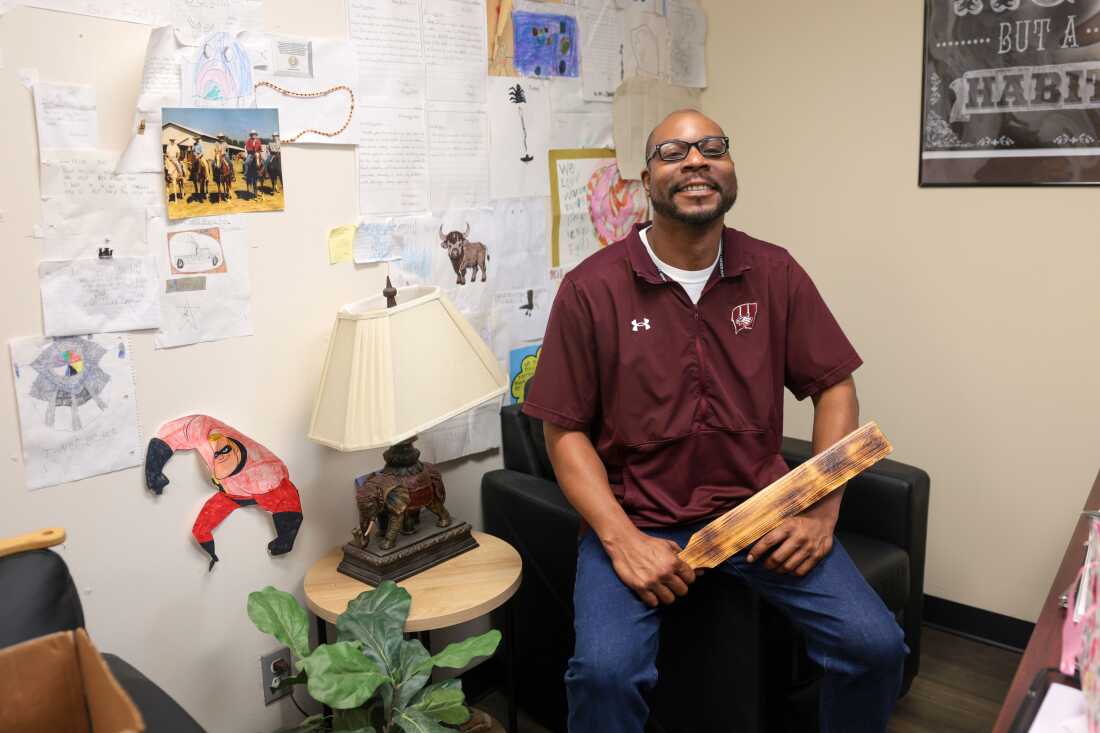
Warner Public Schools' elementary principal, Alan Gordon, holds one of his paddles in his office. Gordon said a student only receives a paddling after they have been sent to his office multiple times and have served lunch detention for the same infraction. Mike Simons for NPR hide caption
toggle caption
Mike Simons for NPR
"The shop teacher made my paddles for me," said Gordon, who is Cherokee. "He made me two identical paddles and all my kids, they know, 'Oh, we don't want to see Peace and Harmony.'"
Gordon said a student only receives a paddling after they have been sent to his office multiple times and have served lunch detention for the same infraction. Parents must authorize the use of corporal punishment by signing a form at the beginning of the school year, and Gordon also calls parents before he paddles a student – even, he said, when parents have previously told him to "just swat them. You don't even have to call."
Once that call is done, Gordon said, "I sit right here before I even spank them and we have a conversation about what they did and why we're here and what we're doing."
When it's time for the paddling, he said, he tells the student to focus on a poster above his desk that reads, "Excellence is not an act, but a habit."
Then, he said, "They place their hands flat on the desk, they look at the picture and they spread their legs apart."
And Gordon "swats" them, usually twice.

Gordon's paddles are named Peace (pictured) and Harmony. Mike Simons for NPR hide caption
toggle caption
Mike Simons for NPR
Afterward, he said he often gives the student a hug and tells them they're loved. Occasionally a student gets a nap time. Others get sent right back to class.
"I think people need to understand this: We are not over here advocating for you to beat your child. That is not what that is," Gordon said. "I think that the responsible use of discipline can change kids' lives."
Ultimately, he supports the rights of parents and schools to allow corporal punishment — even if many people, and the research, disagree.
Edited by: Nicole Cohen
Audio story produced by: Kadin Mills and Lauren Migaki
Research by: Will Chase
Visual design and development by: LA Johnson













%20102026%20top%20art%20SOURCE%20Amazon.jpg?mbid=social_retweet)








 English (US) ·
  French (CA) ·
  French (FR) ·