

 1 month ago
18
1 month ago
18
PROTECT YOURSELF with Orgo-Life® QUANTUM TECHNOLOGY
Orgo-Life the new way to the future Advertising by AdpathwayVideos
What did the arbitral tribunal’s award actually achieve?
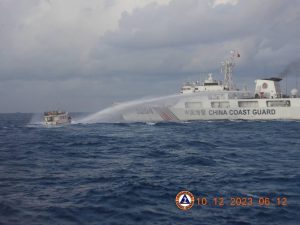
In this photo issued by the Philippine Coast Guard, a China Coast Guard vessel fires a water cannon at a Philippines supply ship in the vicinity of Second Thomas Shoal in the South China Sea, December 10, 2023.
Credit: X/Jay TarrielaAt any moment in the middle of the South China Sea, a literal war could break out. High-pressure water cannons, naval ramming, and high-seas brawls have already become common — and a much bigger conflict is just one mistake away.
But it didn’t have to be this way.
A decade ago, in July 2016, an arbitral tribunal in The Hague issued a ruling in a landmark case pitting the Philippines against China over their competing claims to the South China Sea. The verdict was a bombshell.
Under the United Nations’ Law of the Sea, five judges found that most of China’s claims to vast swaths of the South China Sea were invalid, handing a huge victory to the Philippines.
Beijing dismissed the verdict as a “nothing but a scrap of paper.”
A decade later China hasn’t backed off its illegal claims by a single inch. If anything, the Chinese coast guard is more aggressive than ever. It continues to harass both Philippine coast guard vessels and regular fishermen with water cannons, military-grade lasers, and even ramming attempts. The South China Sea remains one of Asia’s most dangerous flashpoints.
This begs the question: What did the verdict actually achieve? And was one of the biggest international lawsuits in history just a massive waste of time?













 English (US) ·
  French (CA) ·
  French (FR) ·